
Summary: The FAA’s proposed Unmanned Aircraft Flight Restriction (UAFR) framework could give certain defense contractors and subcontractors within the Defense Industrial Base a formal way to restrict drone activity above their property. This guide explains eligibility and requirements for a UAFR for defense contractors, including contractor status, qualifying scopes of work, and what facilities should know about preparing to apply.
What is a UAFR?
In May 2026 the Federal Aviation Administration proposed the Unmanned Aircraft Flight Restriction (UAFR). Owners of critical infrastructure from 16 sectors would be able to apply for a UAFR restricting certain drone operations over their property.
A UAFR establishes an invisible boundary around a facility, however it does not physically stop drones from entering. It simply acts as an invisible no trespassing barrier on official airspace maps and allows law enforcement to penalize the violators.
There are two distinct versions of UAFRs:
Standard UAFR: Available to eligible commercial and public critical infrastructure. For instance, facilities adhering to UAFR defense industrial base sector requirements can use this designation to prohibit unauthorized flights while still allowing rapid transit by vetted, trusted commercial operators (such as Part 107 or Part 135 pilots) who broadcast Remote ID and notify the facility manager in advance.
Special UAFRs: Stricter, highly secure designations reserved for sensitive federal sites or assets facing credible threats, requiring an endorsement from a federal defense, energy, or intelligence agency (such as the DOD or DOE). When a Special UAFR is issued for critical national or homeland security purposes, the FAA may designate the area as "national defense airspace" (under 49 U.S.C. § 40103(b)(3)), meaning willful violations can carry severe federal criminal penalties and prison time.
What Is the Defense Industrial Base Sector?
The Defense Industrial Base (DIB) Sector supports the research, development, design, production, delivery, and maintenance of military weapons systems, subsystems, components, and parts needed to meet U.S. military requirements. It includes Department of Defense (DoD) components, defense contractors and subcontractors, and government-owned or contractor-operated facilities.
For UAFR eligibility, however, the FAA's proposed rule is more specific. A Defense Industrial Base facility must be a DoD contractor or subcontractor located in the United States and perform qualifying mission-critical work.
Who Qualifies for a UAFR for Defense Contractors?
Under the FAA’s proposed rule, a facility must first be a permanent, non-mobile fixed-site facility. Only the owner or proprietor of an eligible fixed-site facility, individually or collectively, would be able to apply for a UAFR.
For facilities within the Defense Industrial Base Sector, the proposed rule includes additional eligibility criteria. The operator or proprietor must demonstrate that the facility is a Department of Defense contractor or subcontractor located in the United States and that its scope of work specifically pertains to the development, production, or support of mission-critical functions such as:
- Aircraft assembly
- Missile defense
- Munitions and energetics
- Nuclear modernization, including nuclear command, control, and communications
- Shipbuilding
- Space launch vehicles, payload construction, and launch sites
- Unmanned systems and counter-unmanned systems
A facility must meet both the DoD contractor or subcontractor requirement and the mission-critical scope-of-work requirement to qualify under the Defense Industrial Base Sector.
What are the Benefits of A UAFR?
UAFR designation delivers substantial operational and security advantages to defense industrial base facilities. This sector enables the research, development, design, production, delivery, and maintenance of military weapons systems, subsystems, and components needed to meet U.S. military requirements. The partnership behind it includes DOD components, more than 100,000 defense industrial base companies and their subcontractors, companies providing incidental materials and services to the DOD, and government-owned or government-operated facilities. Because this sector is essential to mobilizing, deploying, and sustaining military operations, protecting its physical facilities from potential aerial threats carries direct national security weight.
The primary benefit of a UAFR is federally enforceable airspace protection for facilities performing mission critical DOD work. Since UAFR eligibility in this sector is tied to specific, sensitive scopes of work, a UAFR gives contractors and subcontractors a legal tool to restrict drone activity over the exact operations where aerial surveillance or interference would be most damaging.
Production assets in the Defense Industrial Base are highly specialized and deeply interconnected. Because a disruption at a single critical facility can bottleneck the entire supply chain, securing these sites against drone threats is vital for military readiness. A UAFR addresses this vulnerability at the individual facility level.
UAFR designation can also support a contractor's or subcontractor's existing security posture, giving DOD stakeholders and program offices documented evidence of proactive airspace protection layered on top of whatever physical and operational security measures are already in place at the facility.
Protective Security Requirements for a UAFR
Under the FAA’s proposed rule, facilities applying for a UAFR would need to demonstrate that they have layered protective security measures in place. Proposed §74.56 requires:
- Restricted access to the facility, certain areas, or key components
- Designated security personnel
- Security monitoring
- Remote ID receiving capability
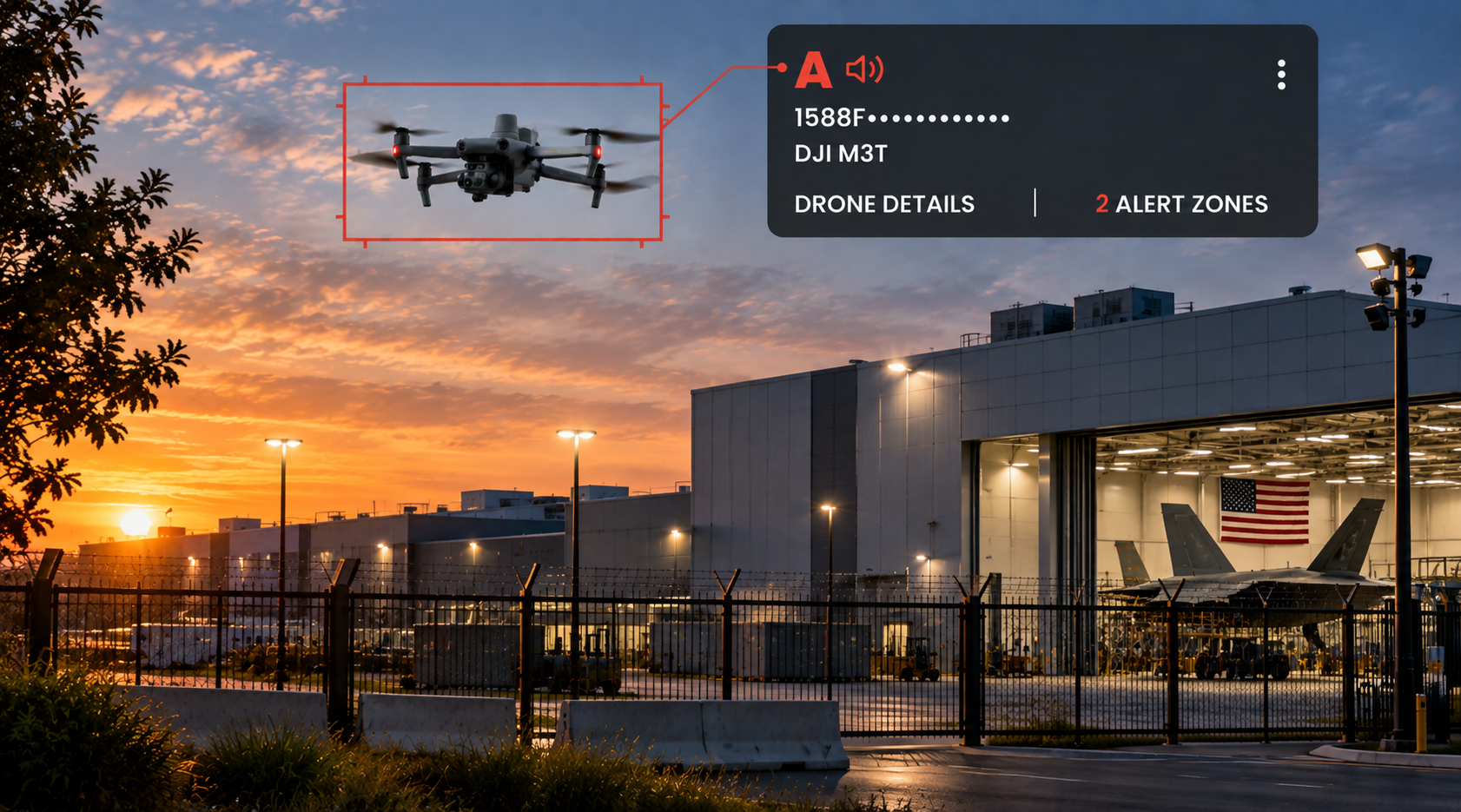
As part of the security monitoring requirement, facilities would need the capability—either directly or through a contracted service—to receive Remote ID broadcasts from drones operating within or in close proximity to the requested UAFR.
The FAA considers Remote ID sensing the minimum technical detection capability necessary for a facility to establish awareness of drone activity around its site.
Three Reasons to Prepare for a UAFR Now
1. Remote ID receiving capability is a proposed requirement.
The FAA’s proposed rule requires applicants to have security monitoring capable of receiving Remote ID broadcasts from drones operating within or in close proximity to the requested UAFR.
2. The application looks backward.
The proposed rule calls for up to 24 months of available historical drone-activity information, including known and unknown operators and operations not associated with the facility. Starting to document drone activity now could provide a more complete historical record when applications open.
3. High application volume could create delays.
The FAA anticipates significant demand once the UAFR application process opens. Facilities that understand the proposed requirements and begin preparing in advance may be better positioned to apply when the process becomes available.
People Also Ask
Can any defense contractor apply for a UAFR?
No. Contractor or subcontractor status alone does not guarantee approval. To be eligible, a fixed-site facility located within the United States must also perform a specifically designated, mission-critical scope of work. This narrow criterion covers highly sensitive areas such as missile defense, aircraft assembly, shipbuilding, nuclear modernization, space launch vehicle construction, and counter-unmanned systems.
What is the difference between a Standard and a Special UAFR for defense sites?
A Standard UAFR protects critical infrastructure by restricting unauthorized flights while allowing pre-vetted, trusted commercial drone operators to transit the airspace. A Special UAFR is a much stricter designation reserved for high-security federal assets or sites facing credible intelligence threats. It requires explicit backing from a federal agency like the DOD and designates the area as national defense airspace, making willful violations a severe criminal offense.
Can defense facilities still utilize drones for internal security if they have a UAFR?
Yes. Holding a UAFR over your own site does not prevent you from using drones for your own operational needs. Facility operators retain full control over who flies within their restricted airspace boundary, meaning internal security teams, infrastructure inspectors, and facility contractors can fly freely with the proprietor's direct permission.