
Summary: The Ultimate Guide to Remote Identification (Remote ID) Detection - understand what Remote ID is, how Remote ID receivers work, how they compare to mobile apps and other detection methods, how organizations across critical infrastructure, corrections, public safety, and government are using Remote ID as their primary airspace security layer, and what the Federal Aviation Administration’s (FAA) proposed Unmanned Aircraft Flight Restriction (UAFR) rule requires in terms of Remote ID sensing capability for facilities seeking a flight restriction.
Drones are now a fixture of daily airspace activity, and the FAA’s Remote ID mandate has become the backbone of how organizations detect them. If you're building an airspace security strategy, you likely have questions: What is Remote ID? How does a Remote ID receiver actually work? Is a mobile app enough? How does it compare to radar? And is it really an effective airspace security tool?
This guide pulls together everything we've published on Remote ID detection into one resource.
The six key topics include:
- What is Remote ID and how does it work?
- Remote ID receivers vs. app: why hardwares matter
- How does Remote ID compare to other detection methods?
- What are the real-world applications of Remote ID detection?
- What does the FAA's proposed UAFR pule require in terms of Remote ID sensing
- Is Remote ID effective, and how do you choose the right setup?
#1. What Is Remote ID and How Does It Work?
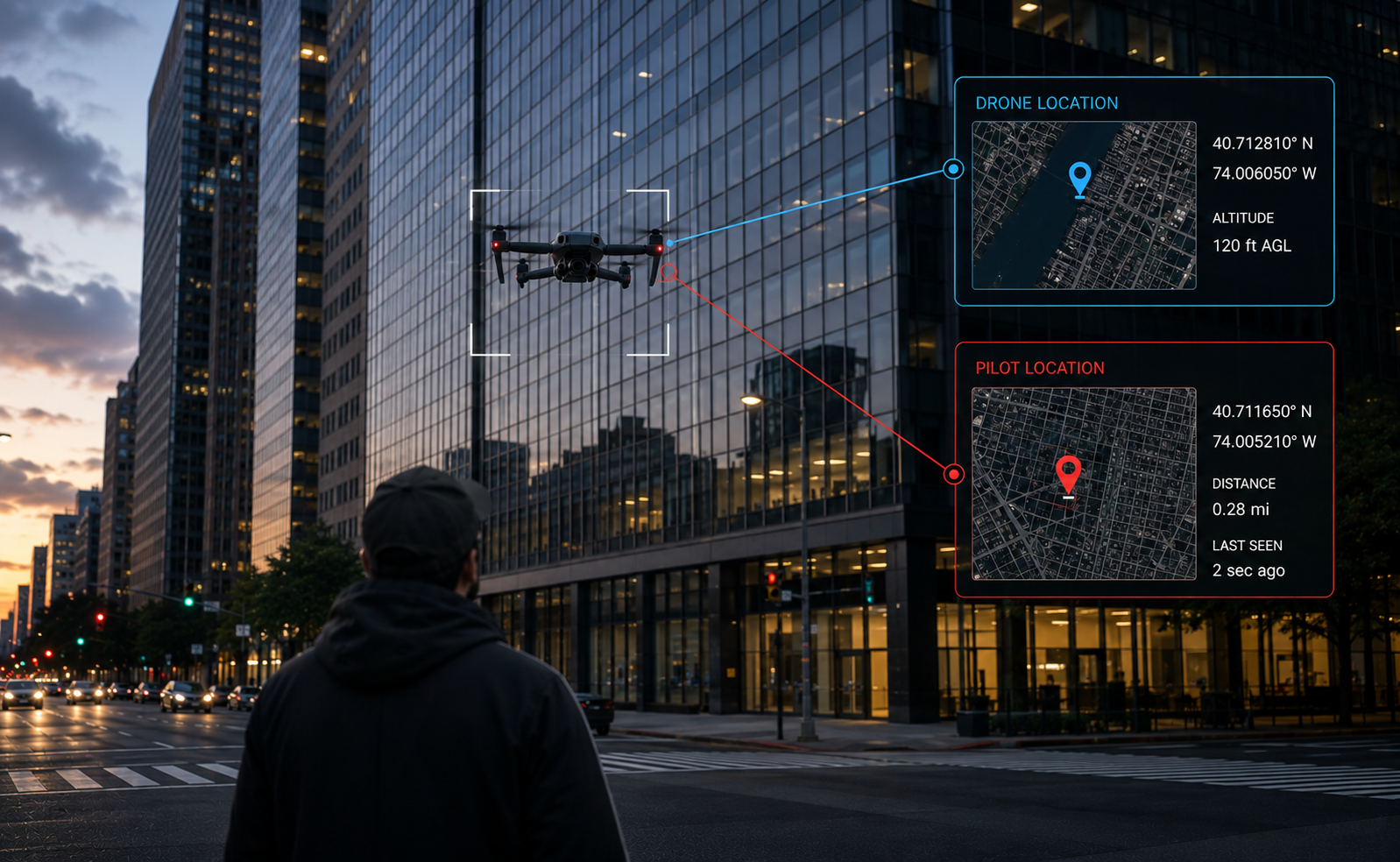
The FAA’s Remote ID rule, codified under 14 CFR Part 89, requires most drones operating in the U.S. airspace to broadcast identification and telemetry data throughout every flight. Think of it as a digital license plate: any drone weighing more than 250 grams at a minimum has to transmit a unique ID, location, altitude, velocity, and the location of its pilot.
Drones manufactured after December 16, 2022 have Remote ID built in from the factory. Older drones need an external broadcast module to comply, or they’re restricted to flying inside a FAA-Recognized Identification Area (FRIA) - a designated low-risk zone where broadcast isn’t required. Given the average consumer drone lifespan of 2 to 4 years due to battery degradation, wear, and crashes, legacy drones are rapidly aging out of the active airspace.
There are two types of compliance worth knowing:
- Standard Remote ID. Built in by the manufacturer, which dynamically updates the pilot’s live location throughout the flight.
- Broadcast Module Remote ID. An aftermarket add-on for older drones, which only transmits the static takeoff location rather than the pilot’s real-time position.
For a full breakdown of what’s required, when the rule took effect, and how the two compliance paths differ, see A Quick Guide to Drone Remote ID.
What Information Does a Remote ID Broadcast Actually Contain?
A compliant broadcast includes drone ID, location, altitude, velocity, operator location, and a timestamp, among other optional fields. In practice, the most useful pieces of that data for a security team are:
- Pilot location - Live and dynamic for standard Remote ID, static for broadcast modules.
- Real-time altitude and speed - Useful for judging intent and timing a response.
- A path to operator identification - The broadcast includes a serial number or session ID. Law enforcement working through the FAA can connect that number to an actual person.
Remote ID provides an exceptional foundation for airspace awareness, acting as a digital license plate that broadcasts real-time telemetry for compliant drones. To build an effective security plan around Remote ID, organizations should account for its specific design parameters—understanding what data it transmits, how receivers process those broadcasts, and how to turn raw signal data into actionable site intelligence. For the full rundown of what the technology provides, read Drones Overhead? What Drone Remote ID Tracking Can and Can't Tell You..
Remote ID gives organizations real actionable intelligence, not just a “drone detected” alert, but a way to make contact with the pilot, execute a safe landing, and question intent. For a closer look at whether this makes remote ID effective as a standalone detection layer, see Is Remote ID an Effective Drone Detection Tool?
#2. Remote ID Receivers vs. Apps: Why Hardware Matters
Once you know Remote ID broadcasts are out there, the next question is how you actually receive them. There are two options: a free mobile app or dedicated receiver hardware. The gap between the two is bigger than most people expect.
Mobile apps rely on a phone’s internal bluetooth and Wi-Fi chips - hardware built for short-range jobs like pairing headphones, not for perimeter security. In hands-on testing, Remote ID apps struggled to detect drones reliably even just a few feet away with a clear line of sight. The result: apps are useful for confirming your own drone is broadcasting correctly, but they’re not built for monitoring an airspace. Interested in hearing more? See Remote ID App vs Remote ID Receiver.
Dedicated Remote ID receivers solve the range problem with high-gain external antennas, and 24/7 outdoor-rated hardware that can track drones and pilots from miles away instead of a few hundred feet.
How Far Can a Remote ID Receiver Actually See?
Range isn’t a single fixed number, it depends heavily on the environment and the hardware being used. RF congestion, line of sight, target altitude, and antenna elevation all play a role. Based on real-world operational deployments, detection distances for the AirWarden Remote ID Receiver range from 1–2 km in dense, high-interference urban environments up to 30+ km in open countryside with a clear line of sight. The full environmental breakdown, along with a side-by-side of market expectations vs. real performance, is in Remote ID Receiver Range: What's the Real-World Distance?
#3. How Does Remote ID Compare to Other Detection Methods?
Remote ID isn’t the only drone detection technology out there, but for many organizations, it delivers the ideal balance of coverage and practicality. Here’s how it stacks up against radar, the next most commonly discussed method.
Remote ID is a passive technology, it listens for broadcasts drones are already required to send.
Radar is active, it emits signals and analyzes what bounces back, which means it can detect drones regardless of whether they're broadcasting. But that comes at a cost:
- Price: Radar hardware and its supporting infrastructure (power, mounting, weatherproofing) carry a significant price tag
- False alarms: Other objects or animals in the airspace can trigger false positives
- Location accuracy: Radar can't identify the pilot's location
- Licensing: Radar is often subject to special-use licensing to avoid interfering with other radar systems
For a detailed comparison of the two technologies, see Drone Detection RADAR vs. Remote ID: What’s the Difference?
What About Drones That Don’t Broadcast?
A common objection: won’t bad actors just disable Remote ID? In practice, it’s far harder than it sounds. Manufacturers hardcode Remote ID into drone firmware, and defeating it requires custom software hacks and hardware modifications well beyond the skill of the average operator, and even most bad actors. The more realistic detection gap is older equipment or drones with technical malfunctions that simply aren’t transmitting, not sophisticated evasion. For the full technical and legal breakdown of why bypassing Remote ID is so difficult, see Think It's Easy to Bypass Remote ID for Drones? Think Again.
Remote ID is one of several drone detection methods, along with RF spectrum sensing, radar, EO/IR, and acoustic sensing. For the full breakdown of how these methods work and when each one makes sense, see our Ultimate Guide to Drone Detection.
#4 Real-World Applications of Remote ID Detection
Remote ID receivers are already protecting a wide range of facility types, each with its own use case for the same underlying technology.
Critical Infrastructure. Power stations, chemical facilities, and industrial sites use wide-area remote ID networks to counter industrial espionage and unknown surveillance, pinpointing a pilot’s location so security personnel and law enforcement can respond.
Correctional Facilities. Drones are a leading contraband delivery method for drugs, weapons, and phones. Remote ID receivers give facility security real-time alerts on a drone’s location, trajectory, and pilot position. This allows security teams to detect surveillance flights aimed at planning a drop or observing staff movements, intercept deliveries before they land, build actionable evidence for prosecution, and establish a consistent response that deters future flight attempts.
Stadiums and Mass Gatherings. Because active mitigation is restricted to authorized law enforcement, commercial venues rely on Remote ID to pinpoint a pilot’s exact location so ground teams can intervene directly - including enforcing FAA Temporary Flight Restrictions (TFRs) during events.
Government and Defense. Multi-site agencies use networked Remote ID receivers to unify airspace monitoring across distributed facilities, from military installations to municipal courthouses, often as the technical baseline required for future airspace protections.
For the full picture of how these use cases play out across sectors, read Commercial Remote ID Receivers: Real-World Use Cases..
#5. What Does the FAA's Proposed UAFR Rule Require in Terms of Remote ID Sensing?
In May 2026, the FAA published a proposed rule that would let operators of critical infrastructure — from energy facilities to state prisons — petition for a UAFR around their site. A UAFR functions as a legal no-fly boundary published on a public FAA database rather than a physical or electromagnetic barrier, giving facility security teams and law enforcement a clear line between compliant and untrusted drone activity.
Buried in the eligibility requirements is a detail that matters directly to anyone reading this guide: under proposed § 74.56, a facility must already have layered protective security measures in place before the FAA will process a UAFR application, and Remote ID sensing capability is one of them. Alongside restricted access, dedicated security personnel, and active monitoring, the FAA proposes requiring that a facility have the capability — directly or through a contracted service — to receive and log broadcast Remote ID signals from drones operating nearby.
In practice, that means Remote ID sensing isn't optional infrastructure for facilities hoping to secure a UAFR, it's a threshold requirement. A site that can't demonstrate functioning detection may not clear the eligibility bar at all, regardless of how compelling its safety or security case otherwise is.
This link between detection and enforceability is also why Remote ID detection and UAFR eligibility are becoming difficult to separate: a UAFR without the ability to sense who is violating it is largely symbolic, since it can only inform enforcement after the fact. Facilities that invest in Remote ID sensing now are better positioned not just to qualify for a UAFR, but to feed that data into their broader security operations — coordinating with local law enforcement, documenting incidents, and building the kind of drone traffic history that the FAA's application process, under proposed § 74.66, will eventually ask them to report.
For the full breakdown of what the FAA’s proposed UAFR rule could mean for security teams and how Remote ID sensing fits into the requirements, read Remote ID Sensing: FAA's UAFR Rule Requires.
#6. Is Remote ID Effective? Choosing the Right Setup
By now you understand what Remote ID is, how it's received, and how it compares to other technologies. The last question is whether it's effective for your organization.
For the vast majority of organizations, a Remote ID receiver network provides all the airspace awareness needed: real-time drone and pilot location, a documented history of activity, and the visibility to support enforcement and investigation. It's also the most cost-effective way to get there, without the infrastructure and licensing overhead that comes with active technologies like radar.
Additional detection layers - RF spectrum sensing or radar - only become worth considering when an organization is seeing signs of drones operating without a Remote ID signal or when an elevated threat level and the budget to match both justify the investment. Assessing your risk level first, rather than defaulting to the most complex system available, is the right starting point for almost every organization.
For a deeper look at Remote ID's effectiveness and capabilities, see:
Is Remote ID an Effective Drone Detection Tool?
Drones Overhead? What Drone Remote ID Tracking Can and Can't Tell You.
Conclusion
Here are the key takeaways from this guide:
- Remote ID is an FAA mandate requiring most drones to broadcast identification, location, and pilot data in real time — a digital license plate for the sky.
- Dedicated Remote ID receiver hardware vastly outperforms mobile apps, offering miles of range instead of a few hundred feet, plus 24/7 reliability.
- Remote ID is passive and pilot-locating; radar is active and can see non-broadcasting drones but not the pilot’s location. Most organizations only need a remote ID receiver.
- Bypassing Remote ID is far more difficult in practice than it's often thought, so the more common detection gap is older or malfunctioning equipment, not evasion.
- Remote ID detection is already protecting critical infrastructure, correctional facilities, stadiums, and government sites — and is becoming a regulatory prerequisite under the FAA's proposed UAFR framework.
- For most organizations, a Remote ID receiver is the right starting point and the only layer needed. Additional layers should be added only when risk level and budget both justify it
People Also Ask (PAA)
What is the main difference between a Remote ID app and a Remote ID receiver?
Mobile apps rely on a smartphone's internal Bluetooth and Wi-Fi chips, which are designed for short-range connectivity and struggle to detect signals beyond a few hundred feet. Dedicated Remote ID receivers use specialized high-gain external antennas, advanced signal filtering, and weather-proof housing to track drones and pilots up to miles away with 24/7/365 coverage and reliability.
Can a Remote ID receiver locate the drone pilot?
Yes. Standard Remote ID broadcasts include the real-time, GPS coordinates of the pilot alongside the drone's position, speed, and altitude. This gives security teams and law enforcement actionable intelligence to locate the operator on the ground while the flight is still in progress.
How does Remote ID compare to radar for drone detection?
Remote ID is passive, low-cost, easy to deploy, and identifies pilot location. Radar is active, emits signals, and detects any physical object in the air, but it carries significantly higher equipment costs, complex installation requirements, and does not provide pilot location.