
Summary: Not every organization needs the same drone detection solution. Understanding drone detection radar vs. Remote ID helps you match the right technology to your actual threat level - without overspending on capabilities you don’t need.

What is Remote ID Drone Detection?
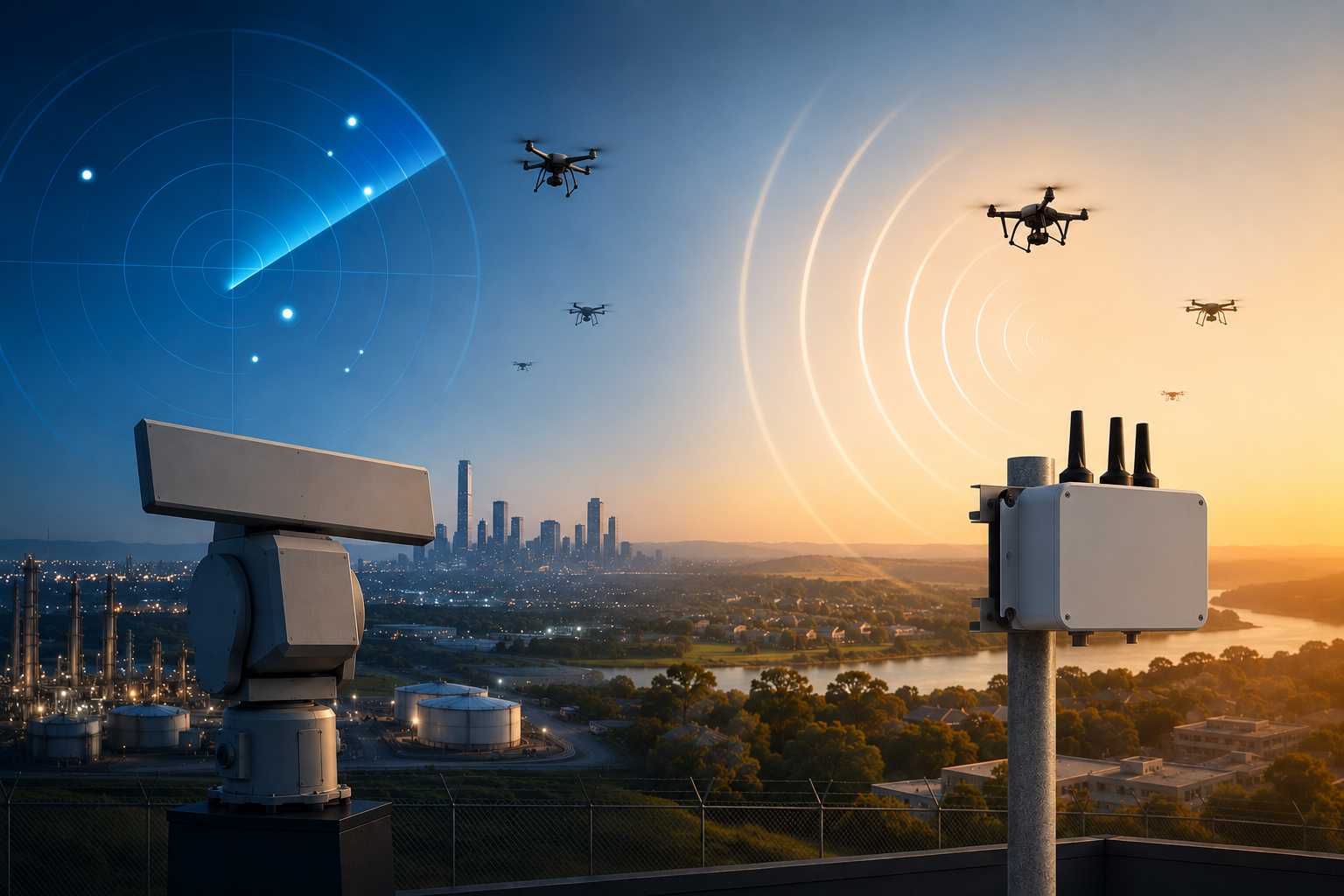
Remote ID drone detection functions as a passive reception system that captures digital identification broadcasts transmitted directly from compliant unmanned aircraft. Under regulations implemented by the Federal Aviation Administration (FAA), most drones operating in the United States are required to broadcast Remote ID information via Radio Frequency (RF) signals. This broadcast protocol functions analogously to a digital license plate, transmitting the aircraft's unique identifier, position coordinates, altitude, velocity, and most importantly, the location of the control station or takeoff point.
Receivers decode the standardized Remote ID messages and relay this intelligence to cloud-based command consoles, providing security personnel with comprehensive situational awareness including both drone and pilot locations. This dual-positioning capability represents a significant operational advantage, enabling response teams to address not only the aircraft but also identify and locate the individual controlling the drone —essential for enforcement, investigation, and threat assessment.
What Is RADAR-Based Drone Detection?
RAdio Detection and Ranging (RADAR)-based drone detection systems represent an active detection methodology that has been adapted from traditional aviation tracking technologies. These systems emit RF signals across designated airspace and analyze the reflected energy that bounces back from objects, including drones. RADAR systems are entirely reliant on the target device size and how well it reflects the RF signal back. When a RADAR pulse encounters a drone's physical structure, if it’s big enough, the signal reflects back to the sensor, allowing the system to calculate the aircraft's position, velocity, and trajectory through sophisticated signal processing algorithms.
RADAR-based detection systems carry a significant price tag, not only for the hardware, but for the infrastructure that is required to support it. This infrastructure includes: power systems, mounting platforms and weatherproofing. Despite the large investment, RADAR still cannot reliably tell you where the pilot is, is susceptible to ground and air clutter in complex environments, may struggle with smaller drone platforms, typically requires special use permissions to ensure it doesn’t interfere with other RADARs in the area, and because of this it makes it more difficult for security teams to respond.
Drone Detection RADAR vs. Remote ID: Side by Side Comparison of Technical Capabilities
|
Remote ID |
RADAR |
|
|
Detection Type |
Passive (receives broadcasts) |
Active (emits signals) |
|
Detection range |
Several miles |
Hundreds of yards to a mile |
|
Make/Model Identification |
Yes |
No |
|
Position accuracy |
Within feet |
Within feet |
|
Pilot location |
Yes |
No |
|
Registration information |
Yes |
No |
|
Installation timeline |
Minutes |
Hours |
|
Cost Per Unit |
<10k |
10k-100k |
|
Detects non-broadcasting drones |
No |
Yes |
|
Infrastructure Required |
Plug and play - minimal infrastructure required |
Power, mounting, structural engineering |
Drone Detection RADAR vs. Remote ID: Side by Side Comparison of Regulatory Compliance and Operational Requirements
|
Remote ID |
RADAR |
|
|
FCC Classification |
Part 15 Unlicensed Device - no transmission license required |
Part 15 - may require specific licensing depending on transmission power and frequency |
|
License Burden |
None - operates like a standard radio receiver |
Potentially significant - varies by system power and frequency allocation |
|
Environmental Review |
|
May be required for high-power systems near ecosystems or residential areas |
|
RF Exposure Compliance |
Not applicable - passive reception only |
Required - must meet FCC guidelines and ANSI/IEEE human exposure standards |
|
Ongoing Compliance Reporting |
No - passive systems eliminate ongoing reporting requirements |
Yes - active transmission systems typically carry continuing obligations |
|
|
Straightforward - Remote ID receivers operate under existing FAA rules with no jurisdiction-specific licensing, making deployment consistent across state lines and federal properties. |
Complex - may require jurisdiction- specific licensing at each site |
|
FAA Mandate Alignment |
Directly aligned - FAA Final Rule (effective 09/16/23) requires nearly all drones to broadcast remote ID |
Not directly addressed by Remote ID rule |
Understanding Layered Airspace Security Options
Building the right drone detection architecture starts with understanding your risk level. For most organizations, Remote ID monitoring serves as both the logical starting point and a complete solution. Additional detection layers are only warranted when risk level and budget both support the investment.
No single detection technology provides complete coverage across all threat scenarios, operational conditions, and adversary capabilities. Before building a detection architecture, organizations securing critical infrastructure, correctional facilities, government installations, or mass gathering venues benefit from understanding drone detection RADAR vs. Remote ID capabilities. When appropriate and budget permits, they can combine Remote ID with spectrum analysis and RADAR to create overlapping detection zones with redundant confirmation.
Explore how Remote ID detection works, including its capabilities, range, and practical applications in our Ultimate Guide to Remote ID Detection.
The foundation of an effective layered architecture typically begins with wide-area Remote ID monitoring through systems like AirWarden® Essentials, deploying networked receivers across the protected perimeter and surrounding approach corridors. This baseline layer provides cost-effective, continuously updated situational awareness of compliant drone traffic, pilot locations, and airspace utilization patterns across extended geographic areas. The system's cloud-based Command Console aggregates detection data from multiple receivers, enabling security operations centers to monitor airspace activity across dozens or hundreds of square miles through a unified interface—essential capability for organizations managing multiple facilities or campus-style installations.
Organizations facing elevated threat profiles or protecting assets where non-compliant drones represent credible concerns should layer RF spectrum sensing into their detection architecture. These advanced RF analysis systems monitor broader signals beyond standardized Remote ID broadcasts, detecting control links from homemade drones, modified commercial systems with disabled Remote ID functionality, or aircraft transmitting no functioning Remote ID signal. Spectrum sensors provide the capability to identify non-cooperative targets that RADAR would detect as unidentified contacts but Remote ID monitoring would miss entirely. This intermediate layer dramatically expands detection coverage while maintaining the operational simplicity of passive RF monitoring.
For the highest-security applications RADAR systems may be incorporated, providing warning of any airborne object regardless of cooperation or emission characteristics. This layered approach enables security teams to distinguish between legitimate manned aviation, compliant drone operations, and potential threats within seconds of initial detection—the rapid discrimination essential for appropriate response escalation and resource allocation.
People Also Ask (PAA)
What is the best drone detection system?
The 'best' drone detection system depends entirely on your specific needs. For most organizations, Remote ID monitoring is the right starting point — and often the only layer needed. Additional technologies like RADAR are worth considering only when risk level and budget both justify the investment.
How does drone detection RADAR work differently from Remote ID receivers?
RADAR actively emits radio frequency signals and analyzes what bounces back, allowing it to detect any drone in the airspace regardless of whether it's transmitting. Remote ID receivers work the opposite way - they passively listen for identification broadcasts that FAA-compliant drones are already required to transmit. One detects by actively probing the airspace; the other detects by reading signals drones are already broadcasting.
Can drones be detected without Remote ID?
Yes. RADAR and RF spectrum sensors can detect drones that aren't broadcasting Remote ID signals, including homemade builds, modified commercial drones, and any drone not actively transmitting a valid Remote ID signal.
How do you detect a drone operator's location?
Remote ID and RF spectrum sensing are currently the only passive detection method that provides operator location, broadcasting the control station or takeoff point alongside the drone's position. RADAR alone cannot identify where the pilot is.