---
title: "Drone Contraband in Prisons: A Guide to Detection and Prevention for Correctional Leaders"
description: Combat drone contraband with this expert guide. Learn how drones bypass security and how to select detection systems to protect your facility's airspace.
image: https://blog.aerodefense.tech/hubfs/Drone-contraband.png
---
[ ](https://aerodefense.tech)
[](https://aerodefense.tech)
[✕](https://blog.aerodefense.tech/drone-contraband#navbar_global)
- [PRODUCTS](https://aerodefense.tech/drone-detection-system-products/)
- [CHALLENGE](https://aerodefense.tech/drone-detection-system-products/unidentified-drones-challenge/)
- [PRODUCTS](https://aerodefense.tech/drone-detection-system-products/)
- [LEGALITY](https://aerodefense.tech/airwarden-legal-drone-detection/)
- [SAFETY ACT](https://aerodefense.tech/dhs-safety-act-designation/)
- [TESTIMONIALS](https://aerodefense.tech/drone-detection-system-products/testimonials/)
- [PRICING](https://aerodefense.tech/drone-detection-system-products/drone-detection-system-price/)
- [USE CASES](https://aerodefense.tech/use-cases/)
- [CORRECTIONAL FACILITIES](https://aerodefense.tech/correctional-facility-drone-detection/)
- [CRITICAL INFRASTRUCUTRE](https://aerodefense.tech/critical-infrastructure-drone-detection/)
- [STADIUMS](https://aerodefense.tech/stadium-drone-detection/)
- [RESOURCES](https://aerodefense.tech/resources)
- [SUPPORT](https://aerodefense.tech/resources/support)
- [RESOURCES](https://aerodefense.tech/resources)
- [BLOG](https://blog.aerodefense.tech/)
- [FAQS](https://aerodefense.tech/resources/frequently-asked-questions)
- [VIDEOS](https://aerodefense.tech/resources/videos)
- [ABOUT US](https://aerodefense.tech/about-us/)
- [CONTACT US](https://aerodefense.tech/contact-aerodefense/)
- [CAREERS](https://aerodefense.tech/aerodefense-careers/)
- [PRESS](https://aerodefense.tech/press/)
- [PARTNERS](https://aerodefense.tech/partners/)
- [ABOUT US](https://aerodefense.tech/about-us/)
- [LOGIN](https://app.aerodefense.tech/)
- [AIRWARDEN ESSENTIALS](https://app.aerodefense.tech/)
- [KNOWLEDGE BASE](http://help.aerodefense.tech/)
- [PRODUCTS](https://aerodefense.tech/drone-detection-system-products/)
- [PRODUCTS](https://aerodefense.tech/drone-detection-system-products/)
- [CHALLENGE](https://aerodefense.tech/drone-detection-system-products/unidentified-drones-challenge/)
- [PRODUCTS](https://aerodefense.tech/drone-detection-system-products/)
- [LEGALITY](https://aerodefense.tech/airwarden-legal-drone-detection/)
- [SAFETY ACT](https://aerodefense.tech/dhs-safety-act-designation/)
- [TESTIMONIALS](https://aerodefense.tech/drone-detection-system-products/testimonials/)
- [PRICING](https://aerodefense.tech/drone-detection-system-products/drone-detection-system-price/)
- [USE CASES](https://aerodefense.tech/use-cases/)
- [USE CASES](https://aerodefense.tech/use-cases/)
- [CORRECTIONAL FACILITIES](https://aerodefense.tech/correctional-facility-drone-detection/)
- [CRITICAL INFRASTRUCUTRE](https://aerodefense.tech/critical-infrastructure-drone-detection/)
- [STADIUMS](https://aerodefense.tech/stadium-drone-detection/)
- [RESOURCES](https://aerodefense.tech/resources)
- [RESOURCES](https://aerodefense.tech/resources)
- [SUPPORT](https://aerodefense.tech/resources/support)
- [RESOURCES](https://aerodefense.tech/resources)
- [BLOG](https://blog.aerodefense.tech/)
- [FAQS](https://aerodefense.tech/resources/frequently-asked-questions)
- [VIDEOS](https://aerodefense.tech/resources/videos)
- [ABOUT US](https://aerodefense.tech/about-us/)
- [ABOUT US](https://aerodefense.tech/about-us/)
- [CONTACT US](https://aerodefense.tech/contact-aerodefense/)
- [CAREERS](https://aerodefense.tech/aerodefense-careers/)
- [PRESS](https://aerodefense.tech/press/)
- [PARTNERS](https://aerodefense.tech/partners/)
- [ABOUT US](https://aerodefense.tech/about-us/)
- [LOGIN](https://app.aerodefense.tech/)
- [LOGIN](https://app.aerodefense.tech/)
- [AIRWARDEN ESSENTIALS](https://app.aerodefense.tech/)
- [KNOWLEDGE BASE](http://help.aerodefense.tech/)
[REQUEST DEMO](https://aerodefense.tech/drone-detection-system-products/#demo)
[FREE TRIAL](https://aerodefense.tech/airwarden-essentials-free-trial/)
[Blog Listing](https://blog.aerodefense.tech) › Drone Contraband in Prisons: A Guide to Detection and Prevention for Correctional Leaders
 By [Lexi Rinaudo, AeroDefense Chief Marketing Officer](https://blog.aerodefense.tech/author/lexi-rinaudo) on January 27, 2026
# Drone Contraband in Prisons: A Guide to Detection and Prevention for Correctional Leaders
[Protecting Correctional Facilities](https://blog.aerodefense.tech/tag/protecting-correctional-facilities)
Share:
Summary: Unauthorized drones have become a growing security threat for prisons and jails, enabling contraband delivery, surveillance, and operational disruption. This guide explains how drones are used against correctional facilities, the risks they create, and how detection technologies support airspace awareness and effective response.
---
## 1. Understanding the Drone Contraband Problem in Prisons and Jails
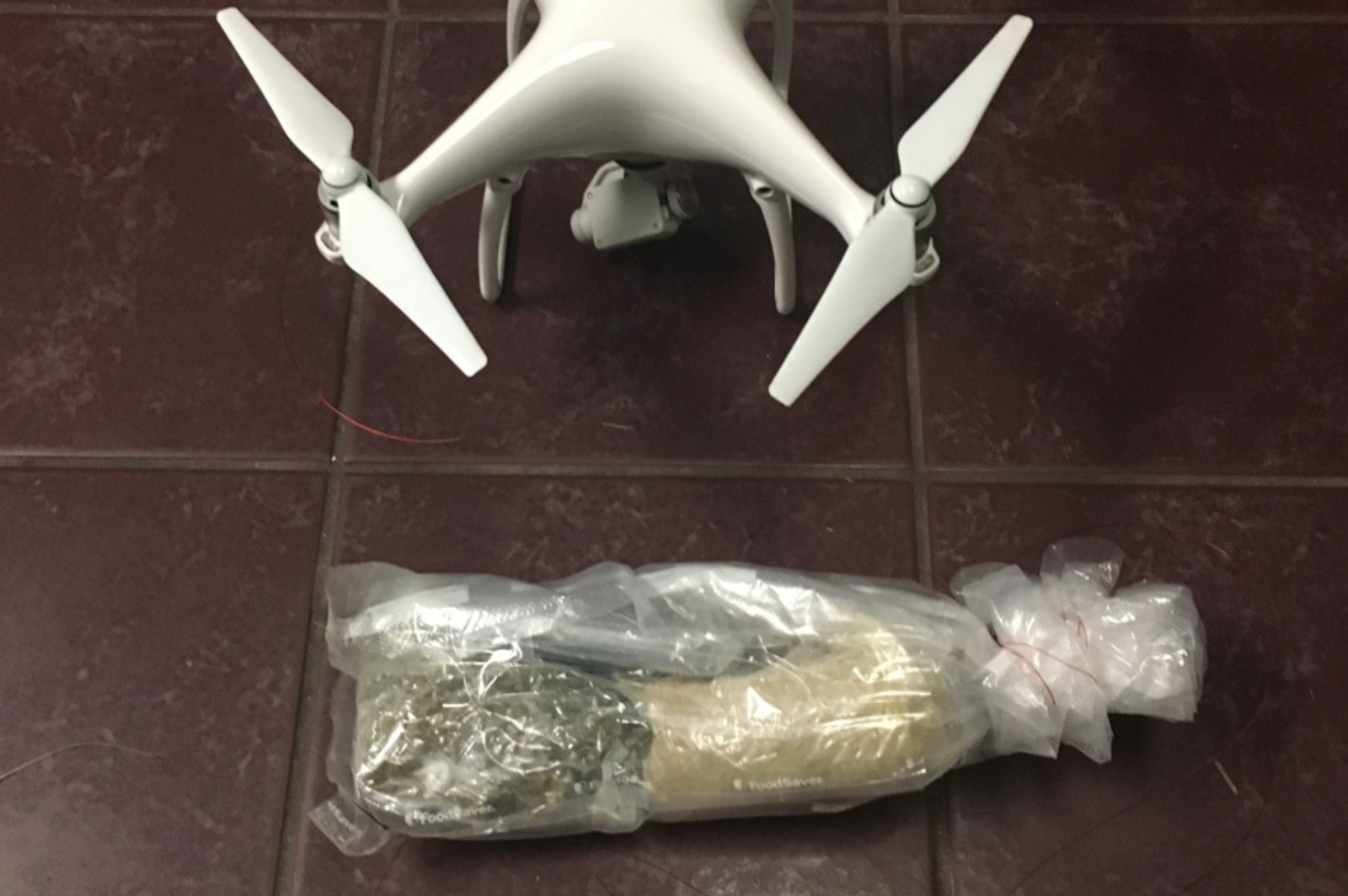
The battle to keep contraband out of correctional facilities is a constant evolution, as criminal organizations rapidly adopt new technologies like drones to bypass traditional security measures such as mail screening, perimeter patrols, and controlled visitation. Drones have become a preferred smuggling method due to their speed, range, and the anonymity they provide to operators outside facility grounds.
These aerial incursions allow smugglers to deliver a wide range of items — from drugs and cell phones to weapons and escape tools — directly into secure areas. While the mechanics of drone smuggling may appear simple, the operational impact on staff safety and facility control is significant.
Our work with the [Georgia Department of Corrections](https://aerodefense.tech/drone-detection-for-prisons-case-study/) (GA DOC), one of our first clients, highlights how these drone incursions play out in real-world correctional environments and the strategies facilities can use to respond effectively.
**For a detailed breakdown of how drones are flown, coordinated, and used to bypass prison security, read:** [*Drone Prison Threats – What Correctional Leaders Need to Know*](https://blog.aerodefense.tech/drone-prison).
## 2. Why Drone Contraband Is Only Part of the Threat
While contraband delivery is the most visible drone-related issue facing correctional facilities, it is far from the only risk. Drones also introduce serious threats related to surveillance, intelligence gathering, and direct interference with physical and electronic security systems.
From an aerial vantage point, drones can be used to observe patrol patterns, identify blind spots, and collect sensitive operational details that would be impossible to obtain from the ground. In some cases, these insights are used to coordinate future incidents, facilitate escapes, or compromise staff safety.
**To understand why drone activity represents a broader security risk beyond smuggling alone, read:** [*3 Reasons Your Jail Needs a Drone Detection System*](https://blog.aerodefense.tech/3-reasons-your-jail-needs-a-drone-detection-system).
## 3. Matching Drone Contraband Risk to the Right Detection Capabilities
Drone threats vary widely by facility type, security level, inmate population, and geography. As a result, effective drone detection is not a one-size-fits-all decision. Correctional leaders must first understand their risk profile before selecting technologies that align with operational needs and budget constraints.
Detection strategies can be tailored to a facility’s risk level. Many prisons may only require a single primary sensor, such as RF detection, to gain basic airspace awareness, with the option to add additional layers later if needed as threats evolve.
**For a deeper look at how correctional facilities can detect, track, and respond to drone-borne contraband, read:** [**Drones Used in Prisons: How Correctional Facilities Can Detect and Stop Contraband Deliveries**](https://blog.aerodefense.tech/drones-used-in-prisons)
## Conclusion: Strengthening Drone Contraband Detection in Prisons
Unauthorized drones present a real and growing challenge for prisons and jails. Gaining visibility into the airspace surrounding a facility is now a critical component of modern correctional security.
By understanding how drones are used, recognizing the full scope of the risks they introduce, and adopting scalable detection strategies, correctional leaders can move from reactive responses to proactive defense. This guide serves as a starting point — and a hub — to help facilities stay informed, prepared, and resilient as aerial threats continue to evolve.
[](https://blog.aerodefense.tech/hs/cta/wi/redirect?encryptedPayload=AVxigLLGhTmZPMzt%2BCaHdwPBik1%2BikNJ6NQplbEhKTydzQC3rV%2BngUKH7XubnMZJj2Ii4gc6A%2F6kXe5B0AgwH1fyD1h0wST2Btuujoxk%2F729pdtftljBG5Y7YoiYA6FiOEdVXGCBoTWC%2B74TKK4gyLs%2FdcM1yYyiPO3gEOw52riyhNg2OyjBdD6M4zVG2H9YsoJWc%2F0o43nNtSDDFgOIq22kWdZyNHosV5zqHlN20StFgtMCpJrWgrS%2FuME4BykTQar1&webInteractiveContentId=201802038869&portalId=2039414)
## Drone Contraband FAQs
#### Can prisons legally detect drones?
Prisons can legally detect drones as long as the technology adheres to relevant laws and regulations. The most recent federal guidance on drone detection is the [Advisory on the Application of Federal Laws to the Acquisition and Use of Technology to Detect and Mitigate Unmanned Aircraft Systems](https://www.dhs.gov/sites/default/files/publications/20_0817_ogc_interagency-legal-advisory-uas-detection-mitigation-technologies.pdf).
#### Do drone detection systems for corrections identify the pilot?
Certain technologies, like RF spectrum sensors and Remote ID receivers, can detect both drones and the location of their operators. In corrections, locating the pilot is often more critical than spotting the drone itself. Knowing where a pilot is launching drone contraband allows staff to respond in real time—intercepting the operator, coordinating with law enforcement, or preserving evidence before a package enters the facility. Because most drone contraband originates outside the perimeter, operators exploit blind spots in parking lots, rooftops, or wooded areas. Without pilot detection, facilities are left reacting only after contraband has reached the yard or housing area.
#### Are all drones required to broadcast Remote ID?
Most drones in the U.S. must broadcast Remote ID, including drones flown for work (Part 107) or recreational drones over 0.55 pounds (250 g). Very small recreational drones under this weight do not have to broadcast Remote ID, and drones flying in special FAA-approved areas (FRIAs) are also exempt.
#### Why are correctional facilities a target for drones?
Correctional facilities are targeted because drones can bypass physical security measures such as walls, fences, and controlled entry points, allowing contraband to be delivered directly into secure areas. Drones also enable discreet surveillance of staff movements, patrol routes, and security blind spots, making them a powerful tool for both smuggling and intelligence gathering.
#### What are the risks if a drone enters prison airspace?
A drone incursion can introduce contraband such as drugs, cell phones, weapons, or escape tools, directly threatening staff and inmate safety. Drones can also conduct surveillance, exposing patrol patterns, security procedures, and infrastructure vulnerabilities, which increases the risk of coordinated disturbances, escapes, and other serious security breaches.
Categories
**Browse All Categories**
- [Drone Detection](https://blog.aerodefense.tech/tag/drone-detection)
- [Remote ID](https://blog.aerodefense.tech/tag/remote-id)
- [Protecting Critical Infrastructure](https://blog.aerodefense.tech/tag/protecting-critical-infrastructure)
- [Drone Detection Legality](https://blog.aerodefense.tech/tag/drone-detection-legality)
- [Protecting Correctional Facilities](https://blog.aerodefense.tech/tag/protecting-correctional-facilities)
- [Protecting Public Events](https://blog.aerodefense.tech/tag/protecting-public-events)
- [Protecting Military](https://blog.aerodefense.tech/tag/protecting-military)
- [Company News](https://blog.aerodefense.tech/tag/company-news)
#### Book a Demo
Want to see how AeroDefense can protect your airspace? Schedule a personalized meeting or demo with our team and get expert answers to your questions.
[Book A Meeting](https://aerodefense.tech/aerodefense-book-meeting/)
#### Subscribe to Our Blog
Get expert insights on drones, technology, and regulations delivered straight to your inbox.
[Subscribe](https://info.aerodefense.tech/blog-subscription-lp)
#### Just For You
[ 3 Reasons Your Jail Needs a Drone Detection System 5 min read](https://blog.aerodefense.tech/3-reasons-your-jail-needs-a-drone-detection-system) [ Drones Used in Prisons: How Correctional Facilities Can Detect and Stop Contraband Deliveries 9 min read](https://blog.aerodefense.tech/drones-used-in-prisons)
[](https://blog.aerodefense.tech/hs/cta/wi/redirect?encryptedPayload=AVxigLJp53I1G%2FDtn3oGDqBToaOfbewjhxSBOJwZcVoDCEebmjelwRawC82qPvAhJbjM942ly9Cl6Wfs%2B4JNMFWXxswcQpYSE8dd9Pip%2FFfVor90T16JT0eki4%2FmmoEYtWl8JNryi36hCuC3jAPVfFnIUUXsYQkr%2FTKbzTj3xEd%2FS7IuzG%2BII2BW0ygwsthzWLCzWZVpyKJ7vOi15oVG0fmpPlo6gstFeJvbUU8tX1B9HGfBQRhXSXENOw%3D%3D&webInteractiveContentId=192885686865&portalId=2039414)
Published by [Lexi Rinaudo, AeroDefense Chief Marketing Officer](https://blog.aerodefense.tech/author/lexi-rinaudo)
January 27, 2026

Comments
©2026 AeroDefense
-
-
-
-
 
```json
{
"@context" : "https://schema.org",
"@type" : "FAQPage",
"mainEntity" : [ {
"@type" : "Question",
"acceptedAnswer" : {
"@type" : "Answer",
"text" : "Prisons can legally detect drones as long as the technology adheres to relevant laws and regulations. The most recent federal guidance on drone detection is the Advisory on the Application of Federal Laws to the Acquisition and Use of Technology to Detect and Mitigate Unmanned Aircraft Systems."
},
"name" : "Can prisons legally detect drones?"
}, {
"@type" : "Question",
"acceptedAnswer" : {
"@type" : "Answer",
"text" : "Certain technologies, like RF spectrum sensors and Remote ID receivers, can detect both drones and the location of their operators. In corrections, locating the pilot is often more critical than spotting the drone itself. Knowing where a pilot is launching drone contraband allows staff to respond in real time—intercepting the operator, coordinating with law enforcement, or preserving evidence before a package enters the facility. Because most drone contraband originates outside the perimeter, operators exploit blind spots in parking lots, rooftops, or wooded areas. Without pilot detection, facilities are left reacting only after contraband has reached the yard or housing area."
},
"name" : "Do drone detection systems for corrections identify the pilot?"
}, {
"@type" : "Question",
"acceptedAnswer" : {
"@type" : "Answer",
"text" : "Most drones in the U.S. must broadcast Remote ID, including drones flown for work (Part 107) or recreational drones over 0.55 pounds (250 g). Very small recreational drones under this weight do not have to broadcast Remote ID, and drones flying in special FAA-approved areas (FRIAs) are also exempt."
},
"name" : "Are all drones required to broadcast Remote ID?"
}, {
"@type" : "Question",
"acceptedAnswer" : {
"@type" : "Answer",
"text" : "Correctional facilities are targeted because drones can bypass physical security measures such as walls, fences, and controlled entry points, allowing contraband to be delivered directly into secure areas. Drones also enable discreet surveillance of staff movements, patrol routes, and security blind spots, making them a powerful tool for both smuggling and intelligence gathering."
},
"name" : "Why are correctional facilities a target for drones?"
}, {
"@type" : "Question",
"acceptedAnswer" : {
"@type" : "Answer",
"text" : "A drone incursion can introduce contraband such as drugs, cell phones, weapons, or escape tools, directly threatening staff and inmate safety. Drones can also conduct surveillance, exposing patrol patterns, security procedures, and infrastructure vulnerabilities, which increases the risk of coordinated disturbances, escapes, and other serious security breaches."
},
"name" : "What are the risks if a drone enters prison airspace?"
} ]
}
```